Seasonal note, Spring 2026 🌱

What is this?
This is my seasonal note (#seasonote?) for March thru May, a post where I reflect on the previous couple of months' work, alongside other life stuff.
God, where does the time go?
I skipped March, April is in the rear-view mirror, and at time of typing May has mere seconds remaining, so I'm filing this generically under Spring.
I took the photo above in April, on a snowboarding holiday in the French Alps where I did not go snowboarding. My family had fun though! I instead wandered around Flaine marvelling at the fading glory of its Brutalist architecture, ate quite a lot of cheese, and managed not to write any blog posts.
What I've been working on
I was going to say that this period has been bookended by AI, but on reflection it's actually been a fairly constant flow. The new normal? Maybe browse the links at the bottom before jumping to conclusions.
- At the beginning of March I attended Connected by Data's Power and Participation in Public Tech conference – an excellent day in Manchester held in the birthplace of the Trades Union Congress, where AI loomed large. The inimitable Steph Wright from Our AI Collective gave an impassioned keynote, pushing hard on ethics and asking tough questions. There were some engaging panels about civic involvement with AI, and it was heartening to hear some enlightened comments from schoolchildren and community groups. I very much enjoyed hearing Jeni Tennison's insights on the Government Digital Service Responsible AI Advisory Panel which she chairs.
- I tabled an AI discussion paper (sort of a strategy, sort of a how-to guide) with the Research Data Scotland Board in early March. To sharpen definitions and make it less homogeneous, I've split it into three broad use cases – internal productivity, service improvements, and its use in research – and honed opportunities and considerations accordingly.
- Related to that, at our April in-person day I ran an afternoon session on AI, and we covered a lot of ground in a couple of hours. I'm interested in bringing real-world examples to the fore – partly as a way of countering hype, partly to construct more solid building blocks for how we use it internally. Four members of the team talked about where AI is starting to encroach on their life and work in practical, and very different, ways. This made for an absorbing session where people were open and honest about the value they're seeing, and the array of questions the use of AI in different contexts raises. To showcase the sort of thing it's possible to spin up in an hour I built a little step conversion tool to help out in the highly competitive step count challenge our workplace is taking part in.
- I attended the launch of AI Scotland and Scotland's new AI strategy, which was useful to get a view of how Scottish Government plans to prioritise and deliver AI initiatives in both the public and private sectors.
- I was on a panel discussing practical, ethical & safe use of AI in the charity sector at Charity Finance Group's Scotland Conference. I'm also looking forward to taking part in their AI-focused lunchtime plenary session at the Annual Conference in London in June.
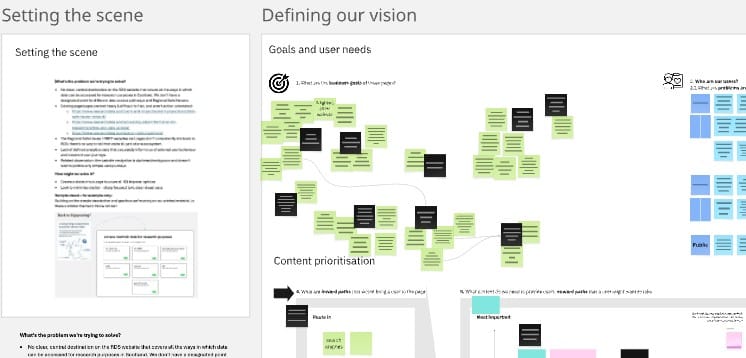
- I've been working with some of the team and Nexer Digital to design and build a more useful entry point to research data services across Scotland, as well as making adjustments to our website navigation, and clean up some content. The screenshot above is from the initial planning session. I'm rarely part of hands-on work these days, so it was a thrill to devote some time to prototyping and thinking through the implications of the changes.
- Finally, and notably, a lot of activity in recent weeks has been spent preparing for our upcoming in-person Board meeting, and considering the organisation's evolving strategy. We also had time away from our desks as a leadership team; two half-day workshops where we formed and stormed more than any of us perhaps thought we needed to. Felt vital and energising.
Hopeful technologists
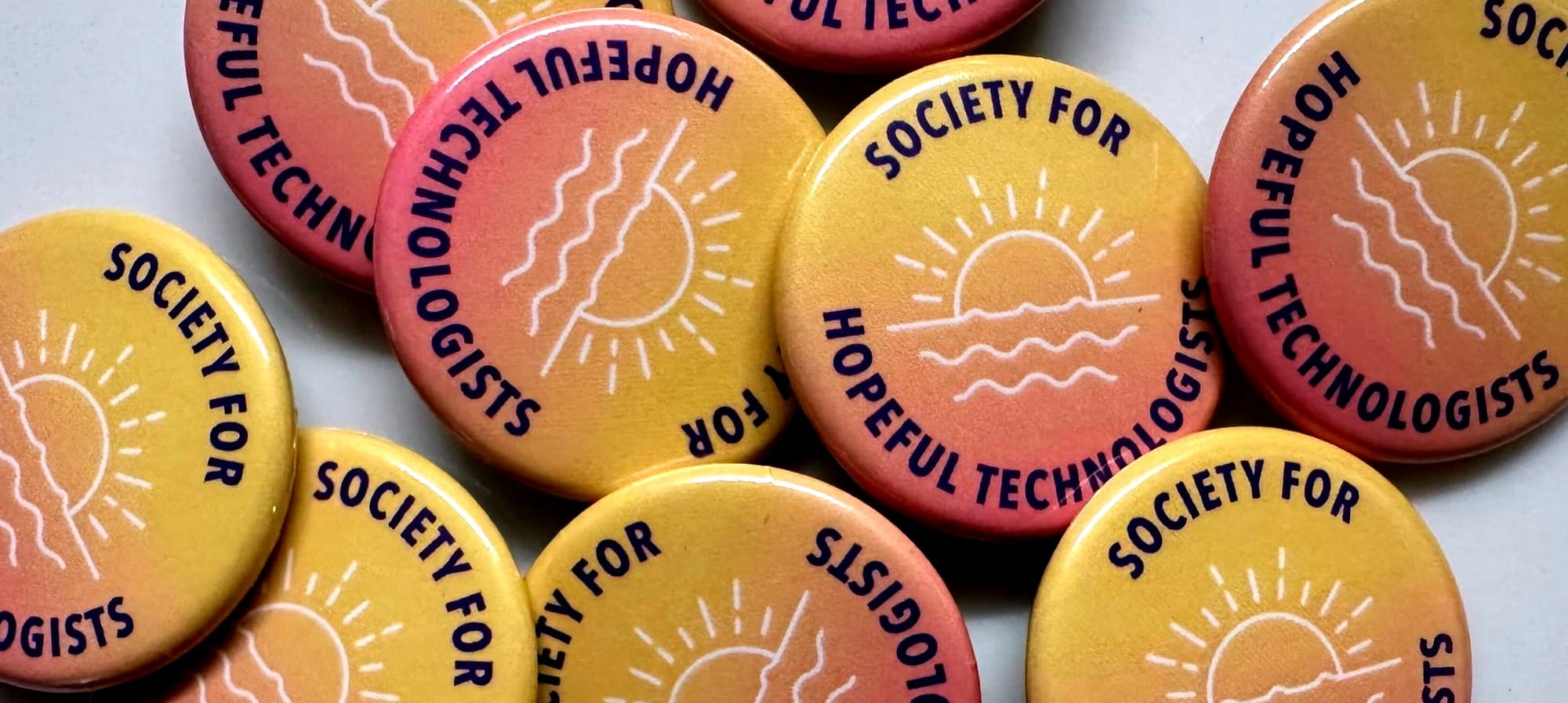
In my spare time, as a sort-of-adjacent-to-the-day-job side project, I've been working with a group of hopeful individuals to help turn Rachel Coldicutt's vision for Society for Hopeful Technologists into a living, breathing thing.
It involves amazing people pitching in in all sorts of ways, with various volunteers collating ideas, divvying up tasks, and forging plans. I've been contributing on the tone of voice and branding work, but perhaps more importantly got a load of badges made for handing out at conferences (see previous post).
Listening, watching, reading
🎧 Listening
I've spent a lot of time with my headphones on of late. My most-played music tracks in March, April and May were:
- Waits For Me by Anjimile
- Life Slime by Pictish Trail
- Drop Dead by Olivia Rodrigo
Special mentions to the feisty new Arab Strap song (particularly the jolly Pet-Shop-Boys-meets-The-KLF video) and Jacob Alon's haunting & beautiful Ivor Novello-winning Don't Fall Asleep.
Patrick Radden Keefe's London Falling: A Mysterious Death in a Gilded City was a near constant companion in my ears as soon as I started listening to the audiobook.
If you haven't sampled Keefe's prose I'd urge you to check out Say Nothing or Empire of Pain, two of my favourite books of the last decade. Like those, London Falling weaves an intricate and often alarming story, this time exploring the murky underbelly of money and aspiration in the capital. Andrew O'Hagan's review, a brilliant read in itself, hits the mark:
"Keefe’s work is so alive that one may say... his reporting has the texture of fiction."
It's definitely worth tuning in to Adam Buxton chewing the fat with Keefe. Centrist dads FTW.
Other podcasts: For a tangible breakdown of AI definitions and the harm of the hype cycle, I heartily recommend this interview with Timnit Gebru. It nails why detail and nuance is all important, and how rolling everything into one giant AI ball only obfuscates the discussion, and benefits the few.

Contrast that with the interview Tony Blair gave on the back of writing a big, long essay last week. The irony of calling for a policy-led debate on the future leadership of The Labour Party, while at the same time repeating bland one-dimensional assertions about 'the artificial intelligence revolution' without any sense of why, what or how was not lost.
📺 Watching
I've both enjoyed and been left slightly underwhelmed with the second seasons of Daredevil Born Again and Beef (sidenote: are these Google overlay easter eggs becoming a bit yawnsome?). Last One Laughing was proper funny. Race Across The World is the sort of show that makes you rejoice the BBC exists – the final episode lifts the lid on the incredible endeavours to capture the competitor's epic journeys. The Kylie documentary was a nostalgic triumph, but far more melancholic than expected.
📖 Reading
More on AI, soz. These five posts have stood out over recent months – some different points of view, but mostly people with an eyebrow firmly raised.
- The AI Great Leap Forward
Han Lee's thought-provoking and darkly funny piece contrasts the AI boom with the Chinese Communist Party's disastrous industrialisation programme of the 1950s and 60s. - We Are (Still) Living in the Long Boring
Freddie deBoer's often personal multi-layered takedown of the AI bubble.
"And the lesson of the last fifty years of digital technology is that software’s limits are the limits of the screen itself. Code cannot insulate your house; no algorithm has ever laid a water pipe; the internet has not built a single mile of high-speed rail."
- Silicon Valley Is Bracing for a Permanent Underclass
Jasmine Sun's not-exactly-upbeat essay in the New York Times analyses the potentially devastating consequences of a mostly-automated world. - The People Do Not Yearn for Automation
Nilay Patel has been snarking away on The Vergecast about his issues with AI industry hyperbole for a wee while, so I'm glad he turned his attention to it on the always entertaining Decoder. It's a compelling 20 minute monologue about what he terms "software brain" and those who "see the whole world as a series of databases that can be controlled with the structured language of software code". - AI = Ain't Inclined
Matt Jukes on fine form describing his own brushes with AI, what he (kind of) finds useful, and where it's a no go for him.
To end on a non-AI note, I really enjoyed Ash's piece on digital confidence, part of his emerging research on the hidden labour that props up many digital endeavours. A timely reminder that it's humans and structures and culture that underpin the way organisations deliver their objectives.
📝 Thank you for reading.
Member discussion