X: why are you still here?
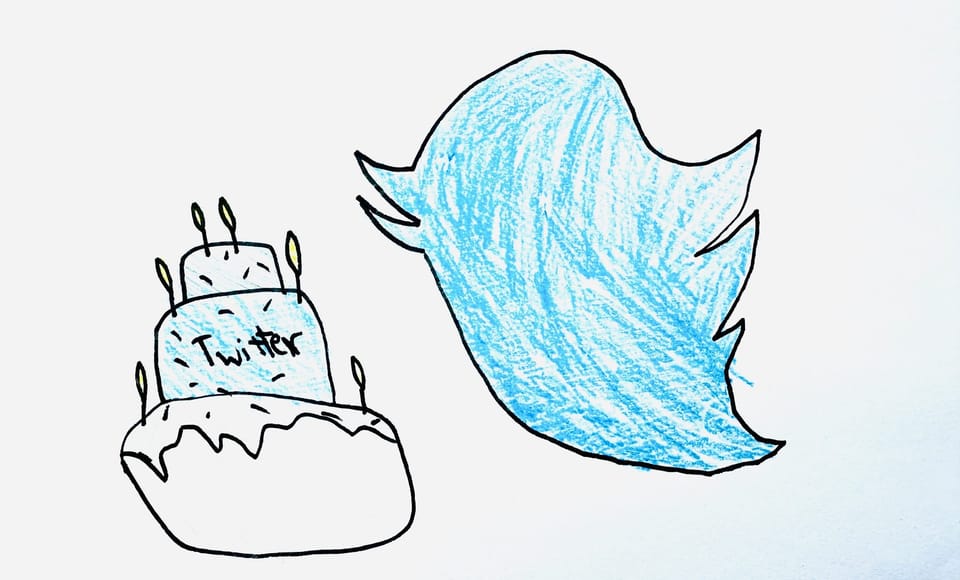
Get your party clothes ready people — next month would have been Twitter's 20th birthday! 🥳
For so it came to pass, on 21 March 2006, Jack Dorsey posted "just setting up my twttr" and an era-defining shift in communications began.
I'm normally sensitive to hyperbolic claims, but I don't think it's an understatement to say the humble tweet has had a seismic impact on, well, just about everything.
Alas, Twitter never made it beyond its teenage years. Sold on to Elon, then hopelessly bent out of shape. The bird app became the everything app and the downward spiral properly kicked in.
While the rot may have been evident long before Twitter's acquisition in 2022, Musk's actions and behaviour have shifted the dial from what felt like an almost-manageable set of underlying issues, to something so far beyond the pale it feels like we've crossed into an alternative reality.
Blame the pandemic, blame the culture wars, blame the algorithms; whatever you attribute the reasons to, content that was once off-limits is the norm. Is this really something we just have to adapt to?
At some point intolerance became the new tolerance, and X has led the way — what a time to be alive. 🤩
The shifting sands of acceptability
I find it hard to fathom why we're still debating the whys and wherefores of remaining on X.
While last month's revelations about the generation of child sexual abuse material and the proliferation of horrendous AI deepfakes by Grok were a new low, they feel like the all too predictable evolution of a platform run by a man whose moral compass possibly never existed.
And as shocking as the most recent events are, we've been in a dizzying loop of this-is-the-final-straw moments since Musk took hold of Twitter's reins.
You can argue that the CSAM issue crosses a particularly sensitive line, but it's the microscopic tip of an almighty iceberg.
Lest we forget the lauding of white supremacists, the unblocking of Neo-Nazis, the gloating over real-world suffering caused by DOGE, the live-streamed support of Tommy Robinson, the cosying up to the German far-right, the unhinged attacks on transgender people. Musk posted about race nearly every day in January.
So what boundaries do need to be overstepped before the organisations and individuals who keep an active presence on X abandon their accounts for good?
Numbers that no longer stack
More and more, the reasons for persisting with X make less and less sense.
Engagement — always difficult to accurately measure — has generally disintegrated in terms of numbers and largely consists of conspiracy theorists, bots, and trolls trading insults with one another.
Take this example of a recent tweet about (wince) vaccinations from the NHS. An account with the best part of 600,000 followers gets a few dozen retweets and a smattering of predictable comments from cranks and Covid deniers.
This pattern is repeated all over the platform, even when followerships are in the millions. Daily postings from seasoned accounts get a handful of reactions but trudge on regardless, like zombies high-fiving a dwindling army of their fellow undead.
Occasionally something bucks the trend — see this tweet from the Green Party on the imminent Manchester by-election — but the discourse is near 100% bile. If the point is to keep a core audience cosy, reach untapped new fans and followers, or prompt informed debate, it's falling wide of the mark.
And yet, and yet, and yet... this excellent study by Andy Tatterstall (with bonus spreadsheet) shows even if things are changing, there are a ton of UK institutions persevering with X.
Pity the poor social media managers spending their working lives staring out at tumbleweed, or arguing with racists.
But it lives on...
As an early Twitter adopter, guilty of the kind of starry-eyed optimism which contributed to the platform's early growth and influence, I saw most of my core OG community drop off by the late 2010s. Save for a small clutch of die-hards, there's practically no-one I know left on X.
While this gradual drop-off is reflected in many other communities, there are particular groups with outsized influence who resolutely refuse to budge (journalists and politicians — that's you!).
And that outsized influence is bad for all of us: it skews what gets reported as news, it rewards sensationalism above level-headed takes, it thrusts certain issues up the political agenda, and it plays into the ambulance chasing that inevitably ensues after stories break.
I've long been suspicious about the volume of technology features floating to the top of the news agenda over the last couple of decades, but it's all part of the same trend: Twitter/X has always slanted towards tech and tech enthusiasts, and that bias gets reflected elsewhere.
If you've ever wondered why a breathless article appears every time an AI chief exec shits or sneezes, you should read this revealing piece about how the premier league bros gaily spar with one another on X. 🤮
With far fewer neutral and non-partisan voices present on X, and paid blue checkmark accounts prioritised in comments, there's much less content around to counter bile and balance out the ecosystem.
You might expect all of this to have had a sizeable impact, to see X’s influence wane in the face of such partial representation.
But, ummm, not really. For all the hand-wringing and angst that accompanies every new X controversy, I’m constantly surprised by how much it continues to be referenced in articles, podcasts and screenshotted on other social networks.
All good things come to an end
The double bind of sticking around on X is understandable: leaving feels like abandoning a professional asset you've spent years building. For journalists, it remains where news breaks first, even if the signal-to-noise ratio has collapsed.
For others, it's institutional inertia — communications teams follow established playbooks even when the metrics scream obsolescence.
It's a lot of sunk cost to get your head around.
But also, twenty years! The world has changed in many, many ways. For good and for bad, social media has too (read The Last Days of Social Media or browse Social Media Signals 2025 for two very different takes on how fragmented and messy it's become).
Large followerships now count for little, tiny accounts can have massive viral moments and all but disappear the next day, people are dispersed over multiple different platforms and channels, and once-public conversations have migrated onto messaging apps like Signal, Telegram and WhatsApp. If news breaks first on X, we really need to question who and what it's representing.
Perhaps the real question isn't whether any single person or organisation should leave X, but what's the cost to our information ecosystem when a platform with this much sustaining influence operates without meaningful moderation or ethical oversight.
Like it or not, everyone ends up drinking from the poisoned well.
Turning tides?
There are encouraging signs of X's decline in Ofcom's latest findings and where publishers intend to focus their efforts, but it's drip-drip rather than a full-on gush.
Maybe the best birthday gift we can get for Twitter is the acceptance it's now a legacy platform: once full of hope and optimism, now bitter, gnarled and steeped in prejudice.
Like the guest that outstays their welcome, a good wine that's soured, or the poo that refuses to flush, it's time to call it and gently consign it to history — for the sake of balance, fairness, and basic human decency.
Happy 20th birthday old friend, your best years truly are behind you.
🍰 Thank you for reading.



Member discussion