It's a run, not a race
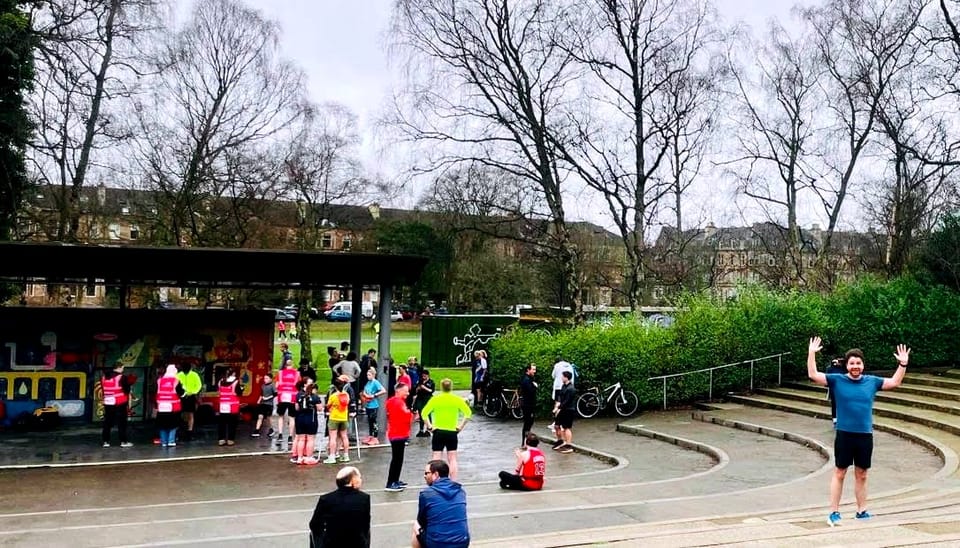
When I turned 50 last year, one of the most noteworthy things I did was rack up my 50th parkrun.
I'd realised a few months earlier that if I timed it carefully, the two things would coincide nicely. Thus I turned 50 on a Thursday and ran my 50th parkrun two days later.
A bunch of family and friends joined in, I raised some money for charity, and we ate croissants and drank coffee afterwards. Yay for synchronicity 🎉
Parkrun, for those unfamiliar with the goings-on in many British parks (and increasingly internationally) on a Saturday morning, is a volunteer-run event where participants complete a 5km course, or 2km for juniors.
People run it, walk it, complete it in wheelchairs, accompany their dogs, or push prams round it. Inclusivity is at its heart, both for those taking part and the many volunteers who give up their time to keep it going.
The phrase "it's a run, not a race" is the mantra parkrun is built around.
You're reminded of it every Saturday, a polite rallying cry: parkrun is for everyone – respect those running with you, respect the park around you, don’t be a dick.
When I turned 51 last month, and ticked off my 66th parkrun, I was reflecting on how my attitude has shifted in my own parkrunning.
For a long time it was about beating my personal best (00:23:51, achieved in 2018, like some chunky Celtic gazelle), then it was keeping below 25 mins, then 26, and now 27.
Increasingly though, it's less about elusive PBs and more about taking part, being grateful I'm healthy enough to compete, and the opportunity to mingle with friends on a Saturday morning.
I've found one of the pleasures of getting older is the ability to process and reconcile things in a different way than I did even two or three years ago. In my fifties I'm chill with the fact I don't move as fast as I once did, my body is showing signs of graceful degredation, and some stuff won't ever quite be the same again.
It's a run, not a race.
Thoughtful tech
Digging into detail when I wrote this, I found a research paper published by Sheffield Hallam University that discusses the ethos behind the technology supporting parkrun.
It's a lovely example of getting the balance right between technology that enables and supports rather than diminishes and distracts.
Just because something can be done doesn't mean it should be. As the paper puts it:
"the low-level technology used by parkrun is a deliberate choice. Despite the availability of a simple wearable chip and timing mat, as used in other mass participation run/walk events, parkrun embraced the barcode scanning method, even enhancing the process by allowing the use of smartphones as barcode scanners.
Rather than providing an automated system, the process of manual scanning promotes social interactions between runners, walkers and volunteers. It connects people in a way that automated timing would not, and intuitively, parkrun have integrated behaviour change techniques into their way of working."
Wouldn't the world be a nicer place if others made such deliberate choices in the tools and technology they adopt? Hey, let's not implement the shiny shiny thing, the stats might be better but people won't talk to one another.
Recently I've been trying to make time for my own thoughtful considerations, particularly while attempting to juggle the whys and wherefores of AI. This is partly because, like many, I've been struck by how recent evolutions in large language models have changed the conversation over the last few months.
I use words like "attempt" and "juggle" deliberately; I don't think there's a particularly straightforward path through any of this, and my own position flip flops constantly.
The whole topic has been adversely affected by polarised takes for years: AI-is-the-future-please-do-not-deviate vs. AI-is-the-devil-it-will-suck-out-our-souls. Maybe it's neither, maybe it's both, maybe – like life in general – there's a messy middle we all have to navigate.
If I were to proffer an overarching piece of advice about the AI debate, it's to find some space to work out what AI means for you: professionally, personally, and in your own messy middle.
I find myself overusing the word "context" at the moment. It bears repeating that with every transformative technology your unique circumstances are all important.
So while the enthusiastic speaker you saw at the inspiring conference, or the podcast featuring the thought leader you usually trust, or the agency with the dazzling-but-vague proclamations, or the tiresome article predicting the jobs most at risk, or the blog post predicting untold economic benefits/catastrophe, or the grumpy Scottish guy whose newsletter you sometimes scroll through, may all have relevant points to make, it's worth remembering they're all based on speculation. And to a greater or lesser extent, they all reflect the context of the messenger.
Try to find a way of cutting through the noise of others. Read widely, talk to sensible peers, consult your colleagues about the genuine challenges they face, ignore 97% of LinkedIn posts, experiment with tech if you've got the bandwidth, but don't jump to conclusions too soon.
It’s a run, not a race.
I'll follow up this post with some more specific AI musings shortly. Maybe my context will be close to your context?
🏃♂️ Thank you for reading.




Member discussion