The legendary Capture the Museum
As we crawl towards the end of the year, I thought I’d write about a nice digital thing. A little seasonal sparkle rather than my usual "bah humbug" vibe.
It's a glass-half-full account of developing something that – despite being over a decade old – still has relevance today.
On the surface it could be seen as a technology story, but it's really about play, people, connections, and what happens when innovation works (even if it doesn’t always work as intended).
What was it?
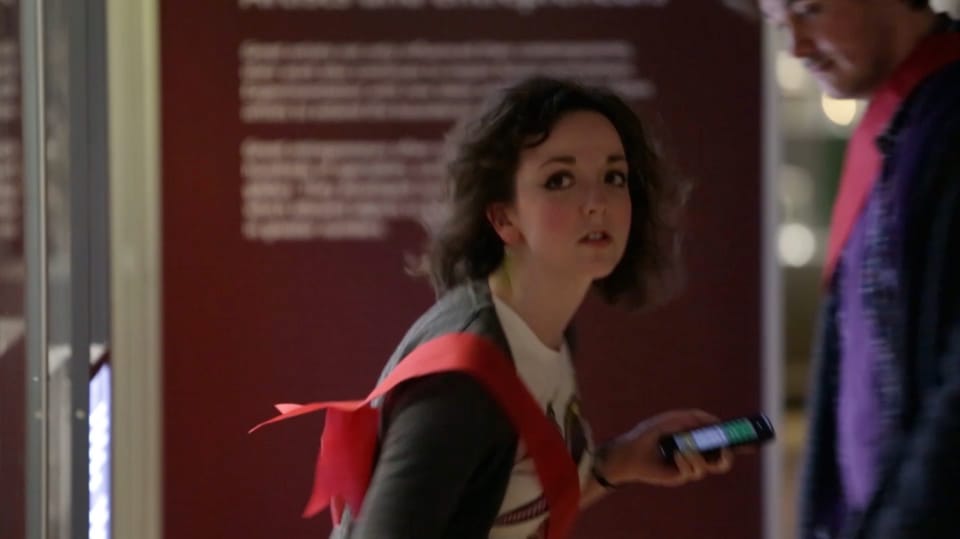
Capture the Museum was a game that used the National Museum of Scotland as its setting.
Launched all the way back in 2013, it reimagined the classic Capture the Flag concept: two teams competed to ‘win’ museum territories by answering questions and completing challenges, using their smartphones to guide them and keep score.
Here's a video all about it:
How did it come about?
In my role at the time with National Museums Scotland I was approached by Innovate UK, the UK’s innovation agency, who were looking to fund digital projects in the culture sector.
Organisations themselves didn't receive funding, instead Innovate UK offered £25,000 to commercial companies to create a digital intervention in a museum, gallery or other cultural space.
I was able to loosely input into the brief, however the final decision was entirely handled by a pre-selected panel.
The lack of voting rights felt more than a little risky. In my experience, successful partnerships between a 'client' and a 'supplier' rely on a blend of capability and chemistry.
Even with the most flawed procurement exercises (and let's face it, that's most of them) there's normally a way to determine if the relationship is going to succeed.
As much as this Blind Date-style procedure felt uncomfortable, any additional budget to develop digital projects was not to be sniffed at.
The nature of funding in the arts in the UK, even as part of a big institution, is precarious.
With technology in particular, a significant chunk goes towards keeping the lights on and staying on top of the basics; new or inventive stuff tends to get done on a shoestring or, on rare occasions, paid for by generous external benefactors.
To put it in context, the sum of £25k almost doubled the (non-staff) digital budget I had to work with at the time, so it represented an unprecedented boost to our fledgling digital operation.
Even so, we were effectively being gifted a project and a team we'd never met and were supposed to just run with – it could have gone very wrong in so many ways.
Thankfully that team were led by Ben and Rosie, with an array of super-talented Thought Den folk beavering away behind the scenes.
Tech and museums
I won't go through the ins and outs of the role digital plays in museums and galleries – see Ash’s excellent piece for a far more up-to-date point of view than mine.
But... in my seven years working in arts and culture I found there were always tensions between the 'physical' and 'digital' museum, and a variety of views on who should take ownership.
It's probably not much of a surprise: the collision between hundreds-of-years-old institutions and emerging technology is bound to throw up a few prickly challenges.
These tensions aren't necessarily sector specific. Scratch the surface of almost any organisation and you'll find digital is interpreted differently between IT, marketing, corporate comms, policy areas, and the C-suite – many of these seeing digital only as a means of delivery or channel, rather than a mindset governing how services and experiences get deployed.
This could be further exacerbated in museums by the blurry boundary between products that lived 'online' as opposed to digital displays available within the physical gallery space – kiosks, touchscreens, interactive exhibits.
Often these are managed by different teams, with different specialisms, even though they're all ultimately about delivering projects using technology.
Anyway, this is a long-winded way of saying that trying to create something outside of the usual parameters wasn't always straightforward.
How did it all go?
I left the museum world almost ten years ago, so I don't want to presume what I've written below necessarily remains relevant.
But I would hope some of it connects with you if you're working in and around digital delivery in a cultural institution.
I've written it in the style of a listicle, which were ALL. THE. RAGE. at the time Capture was being built.
It contains direct quotes from Ben, which I've highlighted in parenthesis.
1. Build on existing concepts
Games can be precarious territory. Successful games often take years to develop, and can cost serious amounts of money. Take this cautionary tale from Niantic and Punchdrunk for example – millions spent on an immersive game that never saw the light of day.
My experience in the culture sector was one where people often wanted products (games, apps, shiny trinkets on websites) to be delivered in short timescales, to cost no more than a few grand, and to have a bucketload of learning objectives baked into them. Oh, and be fun. Oh, and to get people to recommend it to their friends. Oh, and to bring in the much coveted 'young people' audience.
Locking Capture into existing game mechanics helped circumvent some of the trickier conceptual discussions, which in turn allowed us focus on specific elements of the gameplay.
"The core idea – teams battling to capture the museum – just makes sense. People get it, no matter who I explain it to. We built on play conventions people were familiar with (Capture the Flag, Trivial Pursuit, etc)"
We took a solid idea, and stuck to it.
2. Content is (a) killer
The Capture app was a thing of beauty, and I am very much aware the development time put into designing, testing, iterating and deploying the tech far outstripped the original budget.
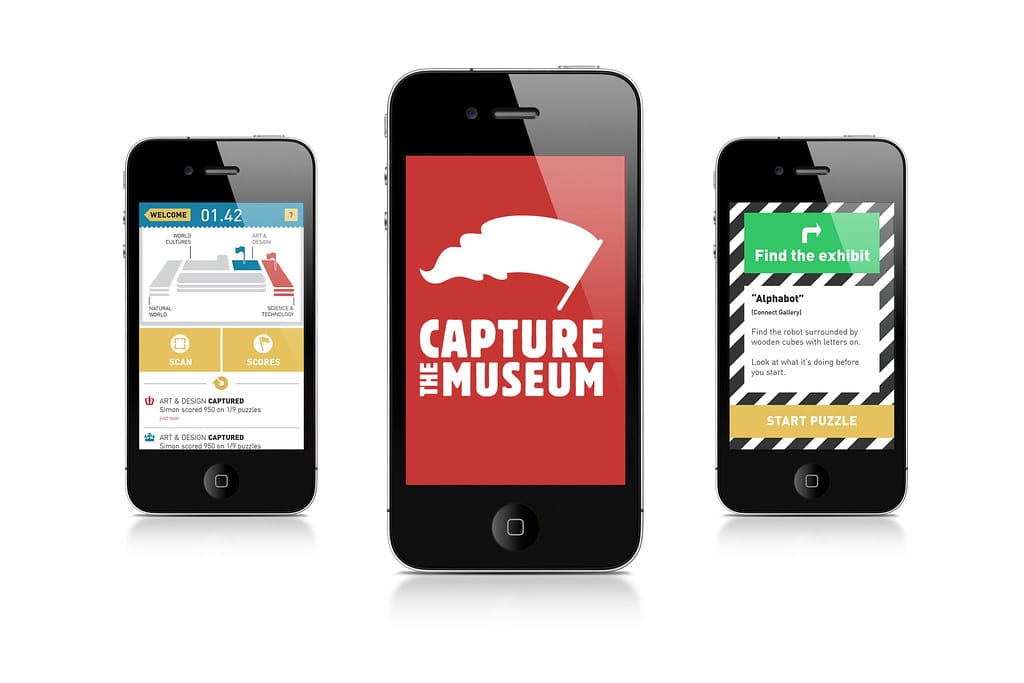
For all of the technical complexity, one of the biggest challenges was the content underpinning the entire game.
Every gallery needed a description, every object needed a backstory, every feature required an explanation. These had to be pithy and intuitive to support the slightly frenetic gameplay
I remember Elaine, the team's extraordinary Content Manager, armed with a notebook or buried in Excel, spending countless hours hacking things into shape.
This proves the maxim: behind most successful projects there's a really bloody well organised spreadsheet.
3. Simpler is often better...
The app cleverly incorporated QR codes as the trigger to reveal different content and features.
Now ubiquitous, and despite being almost twenty years old at that point, it was quite unusual to see them used so extensively.
But they're robust and reliable, and offer a lo-fi way to connect the physical world with the digital. Compared to fiddlier location-based solutions like near-field communication or Bluetooth beacons – which despite much early hype I've never seen used in a compelling, intuitive way – they just work.
Easy to deploy, easy to maintain, inexpensive, adaptable; don't overthink it.
4. ...but you can still try to push boundaries
The rounds of user testing we did with Capture helped to hone some of the more complicated gameplay aspects, particularly in relation to the enormous building we were trying to corral people around, and the amount of information we wanted people to digest.
Some of the more elaborate elements ended up being dialled down in favour of a more refined, easier-to-explain end product.
"We had grand ideas about different characters representing each space, but in fact people just want to run around and not read self-indulgent exposition!"
That said, there were also ambitious features we kept in the game. As the image below shows, the main atrium in the museum is a vast, open space.
At times it gets incredibly busy, as it acts as the main entry point and gateway to multiple galleries.
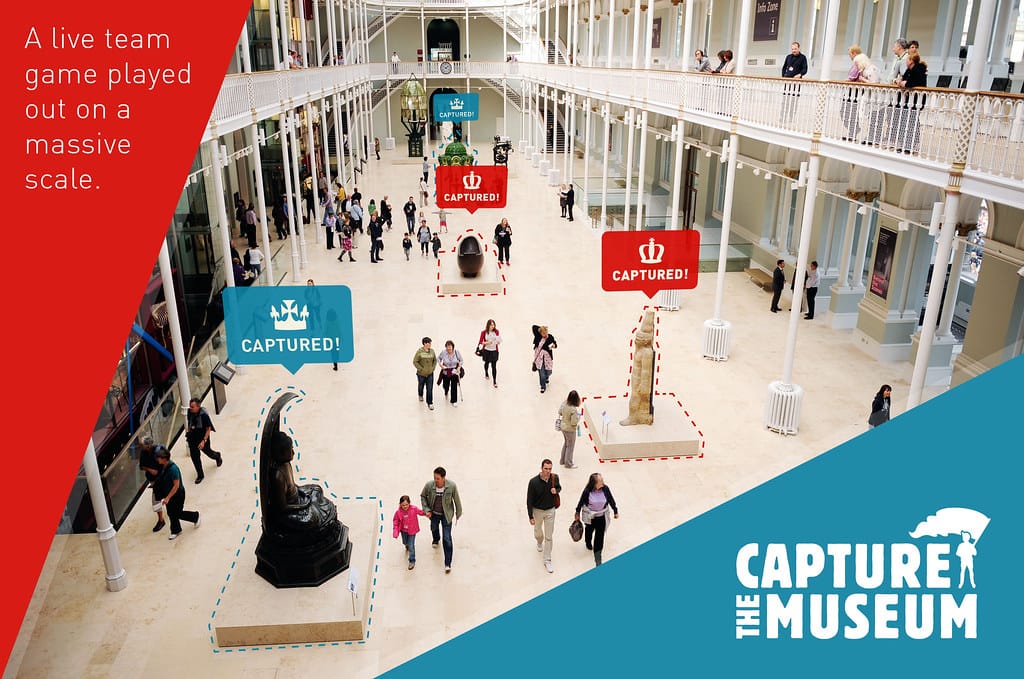
Pulling people away from this thoroughfare was an element we felt was necessary to keep in.
There's an easy, explainable story about encouraging people into galleries they might never have stumbled upon before, which got hardwired into the gameplay:
"I like that we tried to tempt people upstairs (tying into the original brief) by having points multipliers on higher floors"
5. Real-world rewards
I often talked about one of the successful elements of the game was offering 'real-world rewards'. Which is a fancy shmancy way of saying people like stickers.
Competing teams got to go home with a memento of the game, which as well as contributing to a nice fuzzy feeling, also provided an asset to get the word out on social media.
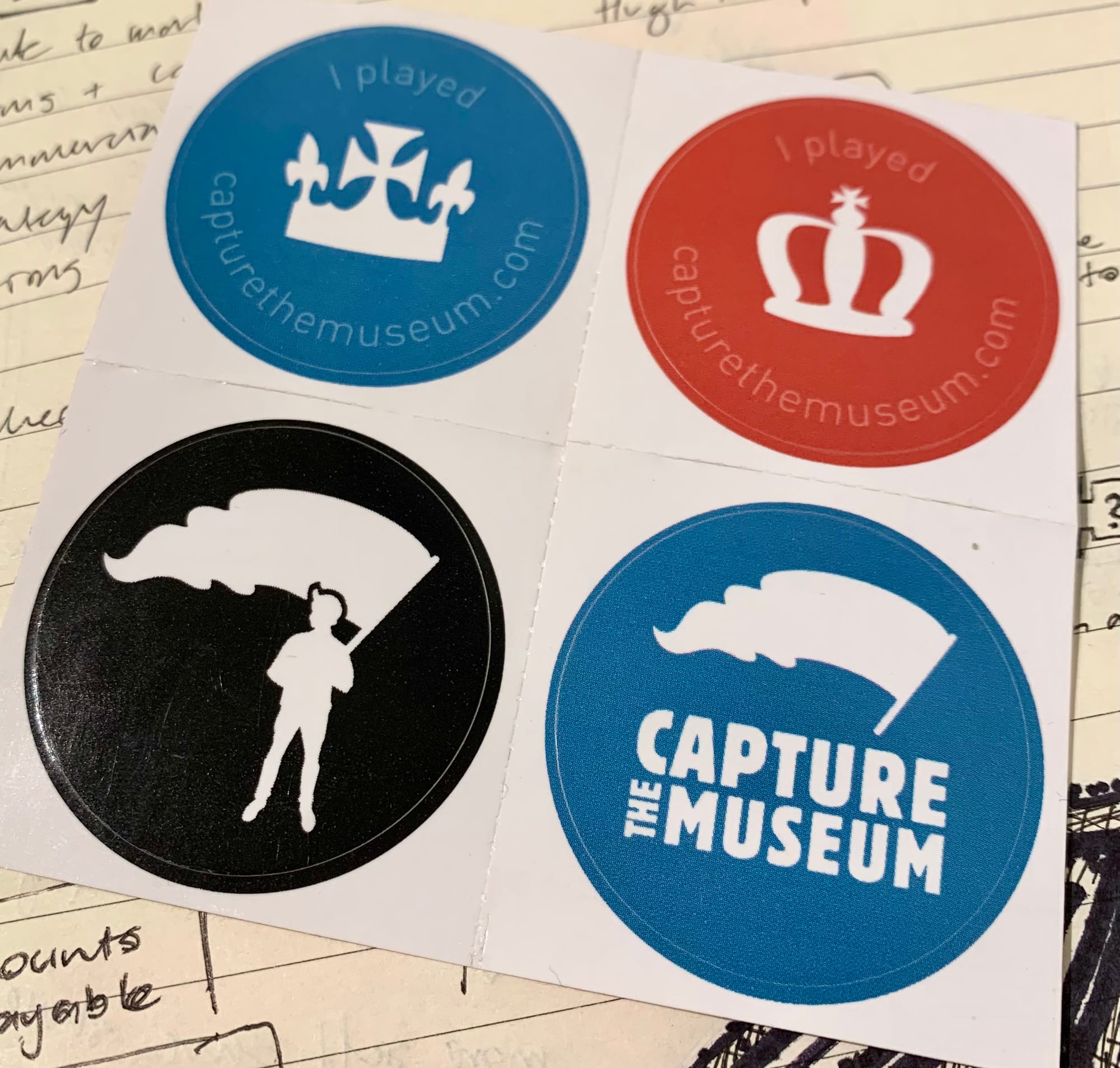
There were other physical components which helped elevate the experience.
"the physical elements (sashes, winners flag) were really important – it helped give people permission to play, and build a sense of ceremony."
As much as digital technology can augment and enhance a museum visit, there's no getting away from the fact it's real objects that pull people in.
6. Every cloud
My biggest regret about Capture is the fact we couldn't make it sustainable. A huge amount of work went into something that was played only a handful of times.
In many ways this wasn't a shock. The development process forced us to deal with various spanners in the works, and highlighted some existing jitteriness about how decisions were made.
Despite the sound advice of close colleagues – masters in seeking forgiveness rather than permission – it was difficult to subtly introduce such an all-encompassing experience.
We would have loved it to flourish, to become more of a museum fixture, to [whisper it] maybe even be commercialised. Alas, it wasn't to be...
Perhaps that's missing the point though.
I learned a hell of a lot from Capture, and I've used knowledge I gleaned during that time into many, many subsequent projects.
When I think about scale, or about defining and deploying products, or about overcoming barriers, I often draw from Capture.
I also forged a lovely friendship with Ben (you should definitely subscribe to his newsletter btw) and still get to benefit from his joie de vivre and superbly creative mind.
As well as that, it's helped me ponder the nature of funding in the arts and beyond.
While I genuinely wish there was more long-termism when it comes to what funders want to back – less shiny schizzle, more infrastructure and data please – there's a lot to be said for being able to trial new ideas and thinking with relatively few strings attached.
That said, I’ve witnessed lots of so-called bleeding edge projects burn through their cash and float off into the great digital dustbin in the sky [cough, AI, cough].
Doing innovation well requires the right people at the helm, and proper consideration of long-term legacy; making sure these kind of investments add genuine value is both an art and a science.
To sum up
So there you go, a nice digital thing.
If you're working on something similar, stuck in those tensions between digital and physical, between what's possible and what's permitted, I hope this post provides some perspective.
There's huge merit in being able to experiment, to learn, to build things that might not last but – many years later – still absolutely matter.
All the best for the festive season. 🎄
Further linkage
- Ben and Rosie are still working with one another, here's a fun project they delivered for the National Trust earlier this year
- National Museums Scotlands' fun AND informative Instagram account


Member discussion